

May . 2024
There are various types of water tests but one thing the experts agree on is that we should get our drinking water tested at least once a year by an accredited lab, sometimes twice a year- summer and winter. Some experts recommend after “weather events” such as flooding and drought. Drought can draw arsenic out of the soil and flooding can cause septic or manure to enter shallow wells or streams.
“You should test your well for bacteria at least once per year or immediately if you notice a change in clarity, colour or taste. If your water source is a shallow well (dug well) or a surface supply then you should test more frequently (e.g. seasonally) as these sources are more susceptible to contamination. Additionally, it is recommended that you install an approved treatment device to disinfect or otherwise remove harmful bacteria, virus and protozoa (e.g. filtration and ultraviolet). Contact your local Drinking Water Officer for advice.
Bacteriological safety is determined by testing for “indicator organisms” called total coliform and E. coli. The presence of these organisms indicates that contamination has entered the well and disease-causing organisms may be present.
Contamination can occur from many sources including the soil or from human and animal waste
including failing septic systems. Chemical Testing: Testing should be done initially when the well
construction is completed and annually thereafter. If there is no significant change in water chemistry over two years then testing can be done every five years. Safe drinking water should meet the most common physical and chemical parameters listed in the Guidelines for Canadian Drinking Water Quality.”
There are several accredited labs around lower Vancouver Island. It is always a good idea to ask around to see which lab or labs others prefer and why. Our first water testing adventure was terrible. We did our test by running the kitchen tap with the filter head off and then had to race to the closest courier. The water sample has to be returned as soon as possible for the sample to be viable and this sample had to go on the ferry then be driven to the lab. It did make it there in time but it was a close thing. The sample analysis came back as a document that seemed as complicated as possible, but included was a kind offer to interpret it for us- for a further fee. Instead, we asked a kind chemist friend and he pronounced, “I’d have a cup of tea at your place anytime”.
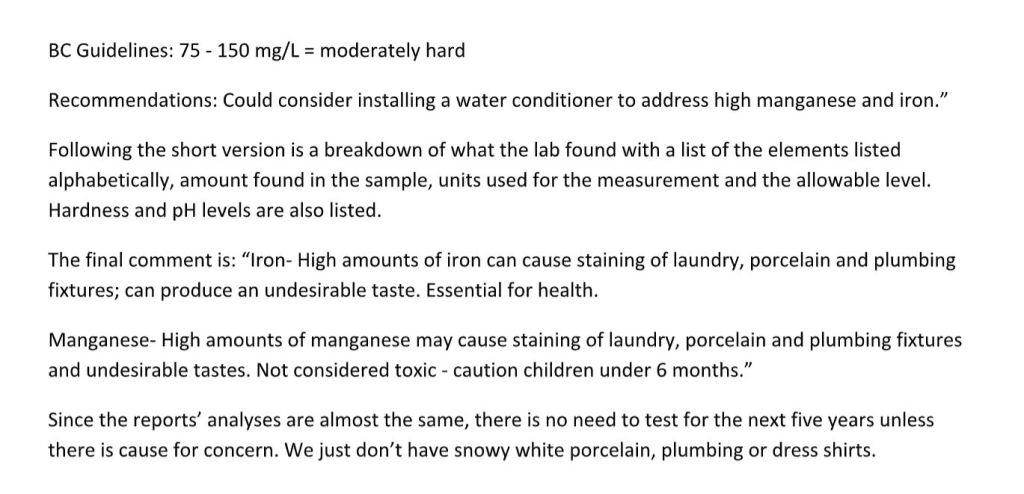
Part of the test results are below from a typical deep well in Otter Point. This does not mean the neighbour’s well would test the same as every well is different. The second water test was done almost three years later and far preferable to the first one. The technicians came and did a thorough well system check and took the water sample. The fast read on the results below:

 OPSRRA