

Health experts tell us to get our potable water tested regularly unless we are on an efficiently operated community treated water system which does testing regularly. Water can develop problems which could make us sick, either quickly noticeable or over the long term.
Bacteria, protozoa, viruses, etc. can make us sick. Basic water testing at a lab usually tests for the presence and count of total coliform, E Coli and fecal coliform. This article looks at coliforms, causes and remedies.
Coliform bacteria are organisms that are present in the environment and in the feces of all warm-blooded animals including humans. Coliform bacteria may not cause illness. However, their presence in drinking water indicates that disease-causing organisms (pathogens) could be in the water system.
The health effects of exposure to disease-causing bacteria, viruses, and parasites in drinking water area vary. The most common symptoms of waterborne illness include nausea, vomiting, and diarrhea.
Sometimes it can clear up on its own without treatment if people do not take any more of the water into their bodies. However, using that water for infants including for mixing formula, the elderly, and those with compromised immune systems may cause more severe effects. In extreme cases some pathogens may infect the lungs, skin, eyes, nervous system, kidneys, or liver and the effects may be more severe, chronic, or even fatal. You should not assume that your water is safe to drink just because it has not made you sick in the past. If bacteria are present in your water, there is a risk that it could make you ill.
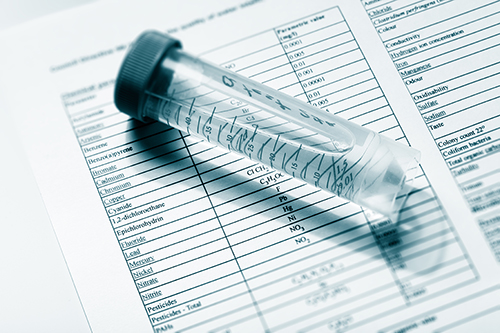
Coliform bacteria have no taste, smell, or colour. They can only be detected through a laboratory test.
The Canadian Drinking Water Quality Guideline for total coliforms is none detectable per 100 mL. The Canadian Drinking Water Quality Guideline for Escherichia coli (E.coli) is none detectable per 100 mL. Maximum Acceptable Concentration for Drinking Water is none detectable per 100 mL. This means that in order to conform to the guideline: For every 100 mL of drinking water tested, no total coliforms or E.coli should be detected.
If your well water test is positive for coliform, it suggests there is a failure to maintain a “closed system” and/or equipment failure. Visually inspect the system including wells, tanks, chlorinator, filters and UV etc. Look for areas where soil, leaves, insects, animals, sewage or animal wastes could get into your system.
When coliforms have been detected, repairs or modifications of the water system may be
required. Boiling the water is advised until disinfection and retesting can confirm that contamination has been eliminated. A defective well is often the cause when coliform bacteria are found in well water. Regularly test your well water for a standard suite of bacterial and chemical parameters, including total coliforms and E.coli. Use an SCC or CALA accredited water testing laboratory. Find a list of accredited laboratories at http://www.cala.ca or http://www.scc.ca . Samples must be kept cool and be delivered to the lab within 24 hours of sampling. The cost can vary widely depending on the lab and the number of parameters being tested. Ask if the lab provides easily understood sample results or if there is an extra charge for interpreting the results.
Test Results: If your test results found bacteria to be present, your water is not safe to drink. Retest your water to confirm the original results. Boil your water while you are waiting for your test results, or use another source for drinking, preparing infant formulas, preparing juices and ice cubes, washing fruits and vegetables, cooking, and brushing your teeth. To destroy pathogens, bring water to a rolling boil for one minute. To kill microorganisms, you must keep water at a rolling boil for at least one minute. Water can be boiled in a pot or kettle on a stove, in a microwave oven, or in an electric kettle without an automatic shut-off.
You do not usually need to boil water for other household purposes. Those who can avoid swallowing the water may shower, bathe and wash using the well water. Toddlers and infants should be sponge bathed. Dishes and laundry may be washed in well water either by hand or machine. If E.coli is present in the water, it means there has been recent fecal contamination and other pathogens may be present. Investigate the source of the bacteria and take corrective measures. If E.coli is absent, but only total coliforms are present, it could mean one of three things:
- A layer of bacteria may have developed within your well or plumbing system. This layer of bacteria is
called a biofilm. - Surface water may be getting into your well. This increases the risk of animal waste contaminating
your water sooner or later. - Your well water may come from an aquifer that contains bacteria. This can happen when groundwater
comes from a shallow source.
The main source of pathogens in drinking water is through recent contamination from human or animal
waste caused by: - Improperly treated septic and sewage discharges
- Leaching of animal manure
- Stormwater runoff
- Domestic animals or wildlife
During and after precipitation, bacteria and other harmful microorganisms from any of these sources may be washed into rivers, lakes, or groundwater. Poor well construction or poor maintenance can increase the risk of groundwater contamination. If E.coli is absent, but only total coliforms are present, solutions depend on why total coliforms are
present: - If a biofilm has developed within your well or plumbing system, you can disinfect your well and
plumbing system. You may need to get expert help. - If surface water is getting into your well, you need to identify how surface water is entering your well and prevent this from happening. You may need the help of a well specialist.
Inspect the well construction and repair or rehabilitate the existing well. Check separation distances between wells and sources of contamination. Determine if there is a source of E.coli near your well, such as a malfunctioning septic system. Reconstruct the existing well, if necessary. In some cases it may be necessary to properly decommission the existing well and construct a new well. Drill a deeper well, which may solve the problem. Be sure to meet the separation distances between your old and new wells. In the interim, use water that has been properly boiled, bottled water, or another source of water that has been tested and found to be safe. The second solution is to install a treatment system to treat your current source of water if there is no other source of water available and correction of the problem is not possible. Many people install a filter and UV treatment system as a safety measure even if no problems are indicated. Compare the cost of drilling a new well to the long-term cost of buying and maintaining a treatment system. - If your well water comes from an aquifer that contains bacteria, which can happen when groundwater comes from a shallow source, you have some options: Use potable water from a different safe source, drill a deeper well, put in a filter and UV treatment system, or put in a reverse osmosis system for any potable water faucets or put in a disinfecting system.
Costs for these choices vary greatly. For systems where the disinfection technology does not leave a disinfectant residual, such as ultraviolet (UV), it may be necessary to shock-chlorinate the well and plumbing system; further information on shock-chlorination is available in the factsheet on wells, available at Be Well Aware – Protect and clean
your well .
- References:
New Brunswick
https://www2.gnb.ca/content/dam/gnb/Departments/hs/pdf/en/HealthyEnvironments/water/Coliforme.pdf - Government of Canada Guidelines for Canadian drinking water quality: Guideline technical
document – Total coliforms
https://www.canada.ca/en/health-canada/services/publications/healthy-living/guidelines-canadian-drinking-water-quality-guideline-technical-document-total-coliforms.html
B.C. Government Environmental Protection and sustainability
https://www2.gov.bc.ca/gov/content/environment/air-land-water/water
 OPSRRA